Salmon Wellington with Spinach: Golden Crust
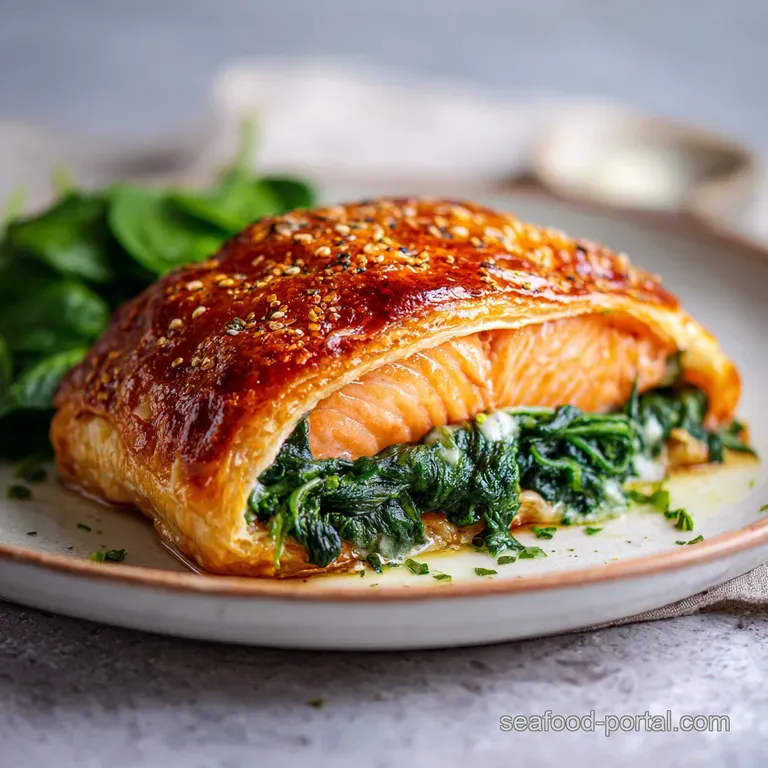
- Time: Active 25 minutes, Passive 25 minutes, Total 50 minutes
- Flavor/Texture Hook: A shatter crisp golden crust yielding to a velvety spinach cream and buttery salmon.
- Perfect for: Holiday centerpieces, anniversary dinners, or impressing the in laws with minimal stress.
- Key Techniques for Flaky Crusts
- Precise Recipe Specifications and Details
- The Essential Building Blocks
- Necessary Equipment for Your Kitchen
- From Initial Prep to Plate
- Avoiding Common Kitchen Disasters
- Smart Dietary Adaptations for All
- Storage and Safe Reheating Tips
- Creative Serving Suggestions and Pairings
- Recipe FAQs
- 📝 Recipe Card
The first time I attempted this dish, it was an absolute disaster. I was so excited to show off for a dinner party, but I didn't dry the spinach properly. When I cut into that beautiful golden log, it didn't slice; it leaked.
A green, watery puddle flooded the plate, and the bottom of my pastry had the consistency of wet cardboard. It was a humbling moment that taught me everything about the importance of moisture control in pastry work.
Indulge in this Easy step-by-step Salmon Wellington Recipe with Spinach for an elegant and flavorful main course. We're going to use a few clever tricks to make sure your results are far better than my first try.
We'll focus on creating layers of flavor that actually stay in their lane, ensuring that every bite has that distinct contrast between the crunch of the puff pastry and the silkiness of the filling.
Key Techniques for Flaky Crusts
The secret to this Salmon Wellington with Spinach lies in the physics of steam and fat. When cold butter in the pastry hits the hot oven air, the water in the butter evaporates instantly. This creates tiny pockets of steam that lift the layers of dough, resulting in that iconic shattering texture.
But if your filling is too wet, that steam comes from the spinach instead of the pastry fat, leading to a "soggy bottom" that ruins the experience.
- Moisture Insulation
- A thin layer of panko breadcrumbs acts as a microscopic sponge, catching juices before they hit the dough.
- Protein Tempering
- Searing the salmon briefly creates a surface seal and ensures the fish finishes cooking at the same moment the pastry browns.
- Thermal Shock
- Keeping the pastry ice cold until it enters the 400°F (200°C) oven maximizes the "puff" by creating an immediate reaction.
- Aromatic Infusion
- Mixing lemon zest and dill directly into the cream cheese distributes flavor evenly without adding excess liquid.
To Prevent a Soggy Bottom
The biggest challenge with any Wellington is managing the liquid released by the fish and greens. We combat this by roughly chopping the 10 oz of baby spinach and sautéing it until every drop of visible water has evaporated. Once it's cool, we mix it with the 4 oz of cream cheese and panko.
This creates a dense, flavorful paste that stays put rather than running all over your pastry sheets.
| Thickness | Internal Temp | Rest Time | Visual Cue |
|---|---|---|---|
| 1 inch | 145°F | 3 mins | Flakes easily with a fork |
| 1.5 inches | 145°F | 5 mins | Opaque throughout the center |
| 0.75 inch | 145°F | 2 mins | Pink center turns pale coral |
Before you start rolling out your dough, it's worth considering how you like your fish finished. While some prefer a slightly translucent center, the USDA recommends 145°F (63°C) for food safety. If you're looking for a slightly different flavor profile for another night, you might enjoy my Salmon with Herb recipe which uses a similar cream based approach but without the pastry.
Precise Recipe Specifications and Details
The beauty of this Salmon Wellington with Spinach is in the specific ratios of the components. We are using 4 center cut fillets, which are naturally more uniform in thickness than tail pieces. This ensures that all four portions cook at the exact same rate.
If you use uneven cuts, you'll end up with one person eating overcooked fish while the other has a raw center.
| Component | Science Role | Pro Secret |
|---|---|---|
| Salmon Fillets | Protein Structure | Pat dry with paper towels to ensure the sear sticks. |
| Baby Spinach | Moisture/Fiber | Squeeze in a kitchen towel to remove "hidden" water. |
| Cream Cheese | Emulsifier/Fat | Use full fat for a stable, velvety mouthfeel. |
| Puff Pastry | Structural Shell | Keep it in the fridge until the very second you need it. |
Getting the pastry right is a balancing act of temperature and timing. If the dough gets too warm, the butter melts into the flour before it hits the oven, and you'll get a flat, greasy cracker instead of a tall, flaky crust.
Always work quickly and don't be afraid to pop the whole tray back in the fridge if you feel the dough getting tacky or limp.
The Essential Building Blocks
Every ingredient in this Salmon Wellington with Spinach serves a purpose. We start with the 1 tbsp of neutral oil in a hot pan to get that initial sear. Don't use extra virgin olive oil here; its smoke point is too low and it might leave a bitter aftertaste on the delicate fish.
The 2 cloves of minced garlic and 1 tbsp of lemon zest provide the high notes that cut through the richness of the cream cheese and salmon fat.
- 4 center cut salmon fillets (6 oz each): The foundation of the dish. Why this? Center cuts provide uniform thickness for even cooking across all four servings.
- 10 oz fresh baby spinach: Roughly chopped for the filling. Why this? Fresh spinach has a brighter flavor and better texture than frozen varieties.
- 4 oz cream cheese: Softened for easy mixing. Why this? Acts as a binder and adds a luxurious, velvety texture to the filling.
- 17 oz frozen puff pastry: Two sheets, thawed but cold. Why this? Provides the structural, flaky "Wellington" shell that everyone loves.
- 2 tbsp fresh dill: Finely chopped. Why this? The classic herbal pairing for salmon, providing a fresh, anise like aroma.
- 2 tbsp panko breadcrumbs: The moisture wicking secret. Why this? Absorbs excess juices to protect the bottom pastry layer from sogginess.
| Original Ingredient | Substitute | Why It Works |
|---|---|---|
| Cream Cheese (4 oz) | Boursin Cheese | Similar fat content. Note: Adds extra garlic and herb punch. |
| Fresh Baby Spinach | Swiss Chard | Leafy texture. Note: Earthier flavor; requires longer sauté time. |
| Panko Breadcrumbs | Crushed Crackers | Dry starch. Note: Adds a slight sweetness and buttery richness. |
If you find yourself out of puff pastry but still have these beautiful fillets, you can always pivot to a Crispy Skin Salmon recipe for a faster weeknight meal. It lacks the pastry drama but keeps that incredible flavor profile. The key is always in the quality of the fish you select at the market.
Necessary Equipment for Your Kitchen
You don't need a professional kitchen to pull this off, but a few specific tools make the step-by-step Salmon Wellington Recipe with Spinach much easier. A large non stick skillet is essential for wilting the spinach and searing the salmon without the delicate skin or flesh sticking to the pan.
You'll also want a solid rolling pin to gently even out your puff pastry sheets without tearing the delicate layers.
Chef's Tip: Use a pizza stone or a heavy duty baking steel if you have one. Preheating it in the oven and placing your baking sheet directly on top of it ensures the bottom of the Wellington gets an immediate blast of heat, guaranteeing a crisp base.
A sharp paring knife is also vital for scoring the top of your pastry. This isn't just for decoration; those little cuts allow steam to escape from the filling. If the steam gets trapped, it builds pressure and can cause your Wellington to "blow out" at the seams, leaking that precious cream cheese filling all over your parchment paper.
From Initial Prep to Plate
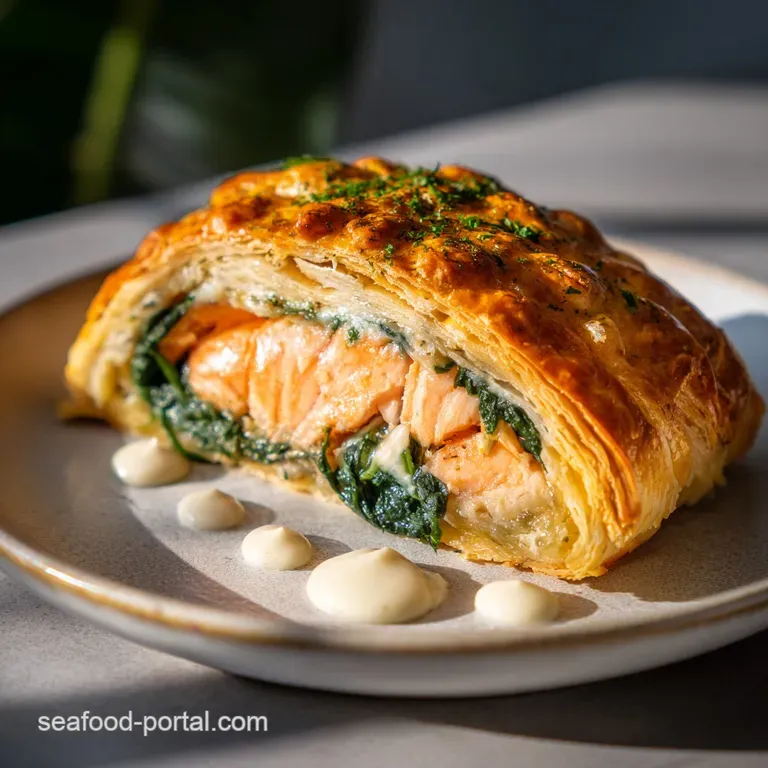
- Sauté the greens. Heat 1 tbsp neutral oil in a pan, add 10 oz chopped spinach and 2 cloves minced garlic. Cook 3 mins until completely wilted and dry.Note: Excess water is the enemy of flaky pastry.
- Mix the filling. In a bowl, combine the cooled spinach with 4 oz cream cheese, 1 tbsp lemon zest, 1 tsp lemon juice, 2 tbsp fresh dill, and 2 tbsp panko. Stir until a thick, uniform paste forms.
- Sear the salmon. Season 4 fillets with 0.5 tsp sea salt and 0.25 tsp pepper. Sear in a hot pan for 1 min per side. Remove when a light golden crust appears.Note: Do not cook through; it finishes in the oven.
- Prepare the pastry. Roll out 17 oz of cold puff pastry into four squares or two large rectangles depending on your preferred size. Work quickly to keep the dough cold.
- Layer the components. Place a portion of the spinach mixture in the center of the pastry. Top with the seared salmon fillet.
- Seal the parcels. Fold the pastry edges over the fish, brushing with an egg wash (1 egg + 1 tbsp water). Press firmly to create a tight seal.
- Score the top. Flip the Wellington so the seam is on the bottom. Lightly etch a diamond pattern into the top.Note: Don't cut all the way through to the fish.
- Apply the glow. Brush the entire exterior with the remaining egg wash and sprinkle with 0.5 tsp flaky sea salt. Until the pastry is fully coated.
- Bake to perfection. Place in a 400°F (200°C) oven for 20-25 mins. Bake until the shell is mahogany brown and crackling.
- Rest before serving. Let the Wellingtons sit for 5 mins on the tray. Wait for the juices to redistribute for a velvety texture.
Avoiding Common Kitchen Disasters
Even experienced cooks can run into trouble with this Wellington Recipe with Spinach. The most common issue is the "leakage" where the filling escapes the pastry. This usually happens because the pastry wasn't sealed tightly enough or the egg wash wasn't used as an effective "glue" during the assembly phase.
If Your Pastry is Raw on Bottom
This is heartbreaking, isn't it? You have a beautiful golden top, but the bottom is doughy. This usually happens if the oven wasn't fully preheated or if the baking sheet was thin and flimsy.
To fix this, you can carefully slide the Wellingtons onto a preheated pizza stone for the last 5 minutes of baking. Next time, try using a dark colored baking sheet, which absorbs heat faster than shiny silver ones.
| Problem | Root Cause | Solution |
|---|---|---|
| Pastry isn't puffing | Dough got too warm | Chill the assembled Wellington for 15 mins before baking. |
| Filling is watery | Spinach wasn't dried | Sauté spinach longer or squeeze it in a clean towel. |
| Salmon is overcooked | Fillets were too thin | Use thick center cut fillets and reduce oven time by 5 mins. |
Mistakes to Avoid Checklist
- ✓ Always thaw puff pastry in the fridge overnight, never on the counter.
- ✓ Pat the salmon completely dry before searing to prevent steaming.
- ✓ Let the spinach and cream cheese mixture cool completely before placing it on the dough.
- ✓ Ensure your oven is truly at 400°F (200°C) using an oven thermometer.
- ✓ Don't skip the egg wash; it's what provides that professional, glossy mahogany finish.
- ✓ Use a sharp knife for scoring; a dull blade will drag the dough and prevent it from rising.
Smart Dietary Adaptations for All
If you need to tweak this Salmon Wellington with Spinach for different dietary needs, it's easier than you think. For a dairy-free version, replace the cream cheese with a thick cashew based "cream" or a firm silken tofu blended with nutritional yeast. You'll still get that creamy contrast without the lactose.
- For a Mediterranean Twist: Add chopped sun dried tomatoes and kalamata olives to the spinach mixture.
- For a Low Carb Experience: Wrap the salmon and spinach in blanched cabbage leaves or large chard leaves instead of pastry.
- For a gluten-free Option: Look for gluten-free puff pastry in the specialty freezer section (it's becoming more common!).
When scaling this recipe for a larger group, don't just double everything blindly. If you're making 8 Wellingtons, work in batches. Don't crowd 8 fillets into one pan to sear them, or they'll steam rather than brown. Also, keep the second batch of pastry in the fridge while you're working on the first four.
Storage and Safe Reheating Tips
Leftover Salmon Wellington with Spinach is actually quite good the next day, though the pastry will lose some of its initial "shatter." Store them in an airtight container in the fridge for up to 2 days.
I don't recommend freezing the cooked Wellingtons, as the salmon can become rubbery and the pastry will turn mushy upon thawing.
- Reheating: Avoid the microwave at all costs! It will turn your pastry into a soggy mess. Instead, place the Wellington on a wire rack over a baking sheet and heat in a 350°F (180°C) oven for 10-12 minutes. This allows hot air to circulate around the pastry, crisping it back up.
- Zero Waste: If you have leftover spinach and cream cheese filling, it makes an incredible spread for toasted bagels or a thickener for a seafood chowder the next day.
Searing the meat does not "seal in juices." This is a common myth. We sear the salmon to develop the Maillard reaction, which adds complex, savory flavors to the crust of the fish. The actual "juiciness" is determined by the internal temperature of the fish, not the sear.
Another myth is that you must make your own puff pastry. Honestly, high-quality store-bought pastry is so good that even many professional chefs use it to save hours of labor.
Creative Serving Suggestions and Pairings
This Salmon Wellington with Spinach is quite rich, so you'll want side dishes that offer some acidity or lightness to balance the plate. A simple arugula salad with a lemon shallot vinaigrette is my go to. The peppery bite of the greens cuts right through the buttery pastry and cream cheese.
- For a Classic Bistro Feel: Serve with roasted asparagus and a spoonful of hollandaise sauce on the side.
- For a Light & Bright Side: Try a cucumber and radish salad with a vinegar based dressing.
- For an Indulgent Meal: Serve alongside a small portion of wild rice pilaf or roasted fingerling potatoes.
If you're looking for a different way to enjoy these flavors, you might consider my Salmon with Feta recipe for a Mediterranean inspired dinner. It has that same creamy, herbal profile but swaps the puff pastry for a salty feta kick. Whatever you choose, the key is keeping the ingredients fresh and the techniques simple.
Right then, you're all set! Just remember: keep that pastry cold, squeeze that spinach dry, and don't be afraid of a little mess on your first try. Cooking is all about the "oops" moments that turn into "aha" moments. Happy baking!

Recipe FAQs
What is the most critical step to prevent the puff pastry from becoming soggy?
Thoroughly drying the spinach after cooking. Excess moisture released from the greens will steam the bottom layer of the pastry, resulting in a wet, doughy base.
How long should I bake the Salmon Wellington at 400°F (200°C)?
Bake for 20 to 25 minutes. The precise time depends on the thickness of your salmon fillet; look for a mahogany brown crust and an internal temperature of 145°F (63°C).
How to ensure the salmon cooks evenly inside the pastry?
Briefly sear the salmon fillets for one minute per side before wrapping. This creates a surface seal that helps regulate the final cooking time and prevents the interior from becoming raw.
Is it true that I must use full fat cream cheese in the spinach layer?
No, but it is highly recommended. Full fat cream cheese acts as a binder and stabilizer for the filling; lower fat versions contain more water and increase the risk of leakage.
How can I make this ahead of time without ruining the pastry texture?
Assemble the entire Wellington, brush with egg wash, and chill for up to 4 hours. Do not bake until just before serving to maintain the cold temperature necessary for puffing.
What is the purpose of adding panko breadcrumbs to the spinach mixture?
Panko acts as a sacrificial moisture absorber. These dry crumbs wick away any residual liquid released by the spinach or salmon juices, protecting the pastry foundation.
How do I reheat leftovers so the pastry gets crisp again?
Reheat in a 350°F (180°C) oven for 10-12 minutes on a wire rack. Using a rack allows air to circulate underneath, which helps restore the crust; avoid the microwave entirely.
Salmon Wellington With Spinach
Ingredients:
Instructions:
Nutrition Facts:
| Calories | 862 calories |
|---|---|
| Protein | 44g |
| Fat | 58g |
| Carbs | 42g |
| Fiber | 3g |
| Sugar | 2g |
| Sodium | 780mg |
