Salmon Wellington: Classic Recipe with Creamy Spinach Duxelles and Perfect Pastry

- The Ultimate Centerpiece: Mastering the Classic Salmon Wellington
- Essential Shopping List: Ingredients for Your Puff Pastry Salmon En Croûte
- The Science of Crispness: Why This Salmon Wellington Recipe Delivers
- Step and by-Step Guide: Assembling Your Showstopping Salmon Wellington
- Troubleshooting and Advanced Chef's Techniques
- Make and Ahead Mastery: Storing and Freezing Your Wellington
- Wine Pairings and Side Dishes for Salmon Wellington Success
- Recipe FAQs
- 📝 Recipe Card
The Ultimate Centerpiece: Mastering the Classic Salmon Wellington
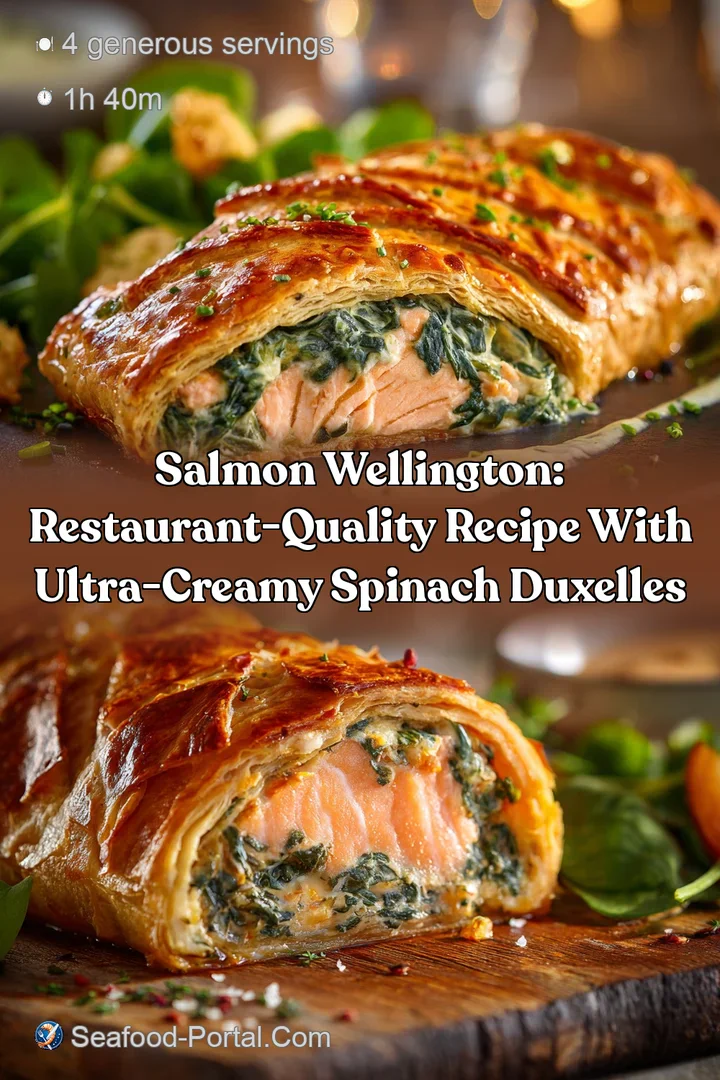
Picture this: that flaky, golden and brown crust cracks under your knife, releasing a plume of aromatic steam, giving way to perfectly cooked, moist salmon nestled in a creamy, green filling. Seriously, the aroma alone when this Salmon Wellington Recipe: Crispy Puff Pastry and Herb Duxelles comes out of the oven? It's magic.
People think Salmon Wellington is reserved for fancy restaurants or chefs who have too much free time. Wrong. This preparation is actually a lifesaver. It’s quick, uses store and bought puff pastry, and you can assemble the whole thing hours ahead of time.
You get all the show and stopping drama with minimal last and minute fuss, which is exactly what we need when hosting.
We aren’t just wrapping fish in pastry here; we are building a textural masterpiece. I’ve made all the mistakes soggy bottoms, dry fish so trust me, this recipe is fail and proof. Let’s get you cooking something genuinely impressive.
Why Salmon Wellington is the Perfect Special Occasion Dish
It looks like you spent three days making it, which is the definition of a great centerpiece. But the real genius lies in the construction. The combination of rich, buttery pastry, the savory earthiness of the duxelles filling, and the natural richness of the salmon creates this beautiful, balanced bite.
It's sophisticated without demanding complicated knife skills or fancy sauces.
Anatomy of the Perfect En Croûte: Pastry, Duxelles, and Salmon
To nail this, you need to understand the three layers. First, the salmon must be perfectly dried and seasoned. Second, we use a mushroom and spinach duxelles —cooked down until unbelievably concentrated which serves two critical purposes: flavor and moisture absorption.
It’s the shield that protects your bottom pastry layer. Third, the puff pastry needs to be cold, rolled correctly, and sealed tight. It’s all about heat management and barriers.
Prepping for Success: Tools and Timelines
You absolutely need parchment paper for easy handling, and a good pastry brush is a must for that golden egg wash. The most important tool, though, is your refrigerator. Don’t skip the chilling step.
Chilling the assembled Wellington for 30 minutes tightens the pastry, ensuring maximum height and flakiness when it hits the hot oven. If you skip this, the butter melts too fast, and the pastry spreads instead of rising.
I made that mistake once, and my Wellington looked like a sad, flat pancake. Never again!
Essential Shopping List: Ingredients for Your Puff Pastry Salmon En Croûte
We’re keeping this manageable, but quality counts here. Especially with the puff pastry if you can find an all and butter brand, splurge. It makes a huge difference in flavor and lift.
| Ingredient | Role | Substitute & My Opinionated Take |
|---|---|---|
| Salmon Fillet (1.5 lbs, skinless) | The star! | Use a thicker cut of cod loin if salmon isn't available, but salmon's oiliness truly makes the dish. |
| Puff Pastry (2 sheets) | The envelope. | If you can’t get all and butter pastry, make sure the standard one is very cold. Filo pastry works in a pinch but needs more layering. |
| Cream Cheese (full and fat) | Binder for duxelles. | Boursin (Garlic & Herb variety) is an amazing substitution for extra flavor. If you must, use ricotta cheese thickened with a touch of breadcrumbs. |
| Shallots & Garlic | Aromatics. | Yellow onion works, but shallots are milder and finer, blending better into the duxelles. |
| Fresh Dill | Essential flavor pairing. | Fresh tarragon is a delightful, slightly more anise and flavored substitute. Dried dill? Skip it; it's weak. |
| Egg (1 Large) | The golden wash. | You need a proper egg wash (egg + splash of water) for color and shine. Milk or cream won't give you the same beautiful sheen. |
The Science of Crispness: Why This Salmon Wellington Recipe Delivers
Choosing the Right Salmon Fillet Size and Cut
The salmon needs to be center and cut, meaning the thickness is mostly uniform across the entire piece. Why? Because if one end is thin and the other is thick, the thin end will be dried out before the thick end is fully cooked. Aim for a fillet that is around 1.5 inches thick. We want consistency.
Pat the fish dry until it squeaks; any surface moisture will ruin the pastry.
Building the Flavor Base: Dill, Cream, and Spinach Duxelles Notes
The duxelles is the secret weapon. It’s a finely chopped mixture of mushrooms, shallots, garlic, and fresh herbs (dill and thyme here), bound with cream cheese. We also add spinach but only after we've wilted it and squeezed out every drop of water.
This filling doesn't just taste amazing; it physically absorbs any residual moisture from the fish or condensation, ensuring that pastry stays crisp.
Puff Pastry Alternatives and Dairy Swaps
Listen, you should be using ready and rolled puff pastry. It saves so much time and effort! But if you need a lighter option, consider using multiple layers of filo. Brush butter on each sheet at least six layers for a delicate crunch.
As for dairy swaps, if you're avoiding cream cheese, softened goat cheese is magnificent here, lending a lovely tanginess that cuts through the richness of the salmon.
Preventing the Soggy Bottom: The Duxelles Moisture Barrier Trick
This is the most critical step. You must cook the duxelles filling for at least 8 to 10 minutes over medium and high heat until it literally forms a paste. It shouldn't look wet or glossy; it should look dry and slightly sticky.
I learned this the hard way: if it’s too wet when you put it on the pastry, the steam will rise, and you’ll have a gray, gummy mess instead of golden flakiness.
Chef's Note: For ultimate soggy and bottom prevention, brush a thin layer of Dijon mustard directly onto the bottom pastry before spreading the duxelles. It creates a subtle barrier and adds a welcome sharpness.
Balancing Richness: Lemon Zest and the Fatty Fish
Salmon is naturally a rich fish, full of delicious Omega-3s. To prevent the whole dish from feeling heavy, we rely on brightness. Fresh dill and a little Dijon mustard help, but my ultimate trick is adding a generous amount of fresh lemon zest to the duxelles mixture.
It doesn't make it taste like lemon; it just makes the whole dish taste fresher and lighter.
Step and by-Step Guide: Assembling Your Showstopping Salmon Wellington

Let’s crack on. This assumes your pastry is thawed and your salmon is dry.
Cooking Down the Duxelles: Extracting Maximum Moisture
- Melt the butter in a large skillet. Add diced shallots and cook until soft (about 3 minutes). Add the finely chopped mushrooms and thyme.
- Turn the heat up to medium and high. Stir constantly for 8– 10 minutes until the mushrooms stop producing water and the mixture thickens into a dense paste. This is non and negotiable!
- Remove from heat. Stir in the well and drained spinach, cream cheese, dill, lemon zest, salt, and pepper.
- Transfer the filling to a bowl and chill it completely in the fridge for at least 20 minutes. Cold filling is essential for a clean assembly.
Laying the Foundation: Shaping the Pastry Bed and Adding the Layers
- Lay one sheet of puff pastry on a piece of parchment paper. Roll it out just a touch to ensure it’s smooth.
- Take half of the chilled duxelles and spread it in the center of the pastry base, forming a rectangle slightly larger than your salmon fillet. Leave a minimum 2 inch border all around.
- Pat the salmon dry one last time, season it heavily with salt and pepper, and brush the top and sides with Dijon mustard.
- Place the salmon directly onto the duxelles base. Spread the remaining duxelles evenly over the top and sides of the fish.
The Critical Fold: Wrapping and Crimping the Edges for a Perfect Seal
- Place the second sheet of pastry over the top of the entire assembly. Gently press down around the sides of the salmon to release any trapped air. This is crucial for even baking.
- Trim the edges, leaving about an inch of excess pastry. Using a fork or your fingers, crimp the two sheets of pastry together tightly to form a perfect seal. A poor seal means escaping steam and deflated pastry.
- Brush the entire surface with the prepared egg wash (whisked egg + 1 tsp water).
The Golden Finish: Egg Washing and Ideal Oven Temperature
- Place the assembled Wellington (still on the parchment) onto a baking sheet. Chill for 30 minutes. I sometimes even toss it in the freezer for 15 minutes if I’m impatient.
- Preheat your oven to a robust 400°F (200° C) .
- Remove the Wellington. Make 2 3 small slits on the top pastry with a sharp knife (these are your steam vents). Lightly score for decoration, if you want.
- Bake for 25– 30 minutes until deep golden brown. Rest for 5– 10 minutes before slicing.
Troubleshooting and Advanced Chef's Techniques
How to Check for Perfect Fish Doneness Without Cutting the Pastry
This is the big question, right? You don't want to cut into your masterpiece only to find raw fish. The most reliable way is using an instant and read thermometer inserted through one of the steam vents or gently pushed through the pastry and into the thickest part of the fish.
You are aiming for an internal temperature of 145°F (63° C) . The great news is that the puff pastry acts like insulation, so the salmon stays moist even if you reach the target temperature right at the 25 minute mark.
Creating Decorative Pastry Scoring and Steam Vents
Scoring is easy and adds so much professional flair. Use the back of a knife or a dull blade to gently draw diagonal lines across the pastry before the final egg wash. Don't cut through! Just score the surface layer. The vents (the small slits) are non and negotiable.
They let steam escape, preventing the pastry from exploding or becoming soggy underneath.
Why is My Pastry Leaking? (And How to Fix It)
Leaking usually means two things: the seal wasn't tight enough, or the filling was too wet. If you notice leakage mid and bake, it’s probably steam and melted butter, which is normal, but if filling is oozing out, the duxelles was too moist.
To fix a minor leak pre and bake, quickly patch it with a small scrap of excess pastry dipped in egg wash. If it happens while baking, there’s not much you can do, so just let it finish. It will still taste fantastic, I promise.
Make and Ahead Mastery: Storing and Freezing Your Wellington
Freezing Raw vs. Cooked Wellington
Yes, this freezes beautifully! I prefer freezing it raw. Once assembled and egg and washed (Step 11), wrap the entire thing tightly in cling film, then foil. Freeze flat for up to 2 months.
To bake from frozen: Unwrap it, egg wash again, and bake at 375°F (190°C) for about 45– 55 minutes. You need a lower temperature and longer time to allow the fish to thaw gently and cook through.
Proper Refrigeration for Leftovers
Leftover slices should be wrapped tightly and stored in the fridge for up to 3 days. We often turn cold leftovers into something else; sometimes I flake the salmon and mix it with some extra cream cheese for a quick version of my Smoked Salmon Bagel Dip: Effortless Cream Cheese Lox Dip Recipe .
Reviving the Crisp: Reheating Methods for Day Two
Never, ever microwave leftover Wellington. It turns the pastry into a sad, rubbery mess. Preheat your oven or toaster oven to 350°F (175°C). Place the slice directly on a wire rack set over a baking sheet (this allows air to circulate underneath).
Reheat for 10– 15 minutes until the pastry is re and crisped and the salmon is warm throughout.
Wine Pairings and Side Dishes for Salmon Wellington Success
Because this dish is rich, you want bright, acidic side dishes. I love serving it with a simple lemon and dressed arugula salad and a pile of buttered asparagus. If you’re feeling ambitious, pair it with my recipe for Poached Salmon Effortless Court Bouillon Method for Moist Buttery Fish as a starter it shows off the versatility of salmon!
For wine, reach for a crisp, high and acid white. A dry Sancerre or a New Zealand Sauvignon Blanc works wonders because the acidity cuts through the richness of the pastry and the fatty salmon. If you prefer red, stick to something very light and chilled, like a Beaujolais.
Serving Suggestion Variation: If you end up with scraps or trimmings, consider making a quick Salmon Chowder Creamy Hearty Smoked Fish Recipe the next day. It's a great way to use up every single bit of flavor.
Recipe FAQs
Why is the bottom of my pastry soggy, and how do I prevent a "soggy bottom"?
A soggy bottom is usually caused by residual moisture escaping the salmon or the filling. To prevent this, ensure your duxelles mixture is cooked down until extremely dry before use, and apply a thin layer of mustard or melted butter directly to the pastry base as a moisture barrier.
Additionally, baking the Wellington on a preheated baking sheet or pizza stone can help crisp the base immediately.
How do I know the salmon is perfectly cooked without slicing into the pastry?
The most accurate method is using an instant read thermometer inserted carefully through the side of the pastry into the thickest part of the salmon fillet. For a medium well finish, aim for an internal temperature of 140°F (60°C).
Remember that the salmon will continue to cook slightly (carry over cooking) while resting.
Can I prepare the Salmon Wellington ahead of time, and if so, how should I store it?
Yes, you can fully assemble the Wellington (including the egg wash) up to 24 hours in advance. Place it uncovered on a baking sheet in the refrigerator for 30 minutes to firm up, then cover loosely with plastic wrap until you are ready to bake.
Ensuring the pastry is completely chilled before baking helps guarantee a beautiful rise.
My pastry browned too quickly, but the salmon isn't done yet. What should I do?
If the pastry is browning rapidly, gently tent the Wellington with aluminum foil for the remainder of the baking time. This insulation slows the browning process of the crust while allowing the internal temperature of the salmon to reach the necessary mark.
You may also slightly reduce your oven temperature by 25°F.
I don't like mushrooms. What is a suitable alternative for the creamy duxelles filling?
The filling is important for both flavor and acting as a moisture barrier between the fish and pastry. A great substitute is a blend of finely chopped, blanched spinach and dill mixed with soft cream cheese or mascarpone, ensuring the mixture is very thick and spreadable.
Alternatively, a thin layer of pesto can provide similar moisture resistance and flavor.
Can the assembled, unbaked Wellington be frozen?
The Wellington freezes excellently. Assemble the dish, place it on a tray, and freeze until solid before wrapping tightly in plastic wrap and aluminum foil. To cook, bake straight from frozen (do not thaw) at the original temperature, but add approximately 20 30 minutes to the cooking time.
How long should I rest the Salmon Wellington before slicing and serving?
Resting is crucial for any protein encased in pastry to ensure perfect slicing. Allow the Wellington to rest on a wire rack for a minimum of 8 to 10 minutes after removal from the oven. This allows the internal juices to redistribute and prevents the filling from spilling out when the pastry is cut.
Classic Salmon Wellington Recipe

Ingredients:
Instructions:
Nutrition Facts:
| Calories | 619 kcal |
|---|---|
| Protein | 32.0 g |
| Fat | 43.0 g |
| Carbs | 24.0 g |
